Is Cloudflare the Host? How to Route an Abuse Report
A privacy-safe checklist for identifying Cloudflare’s role, recording exact URLs, and sending each report to the provider positioned to act.
Seeing Cloudflare on a domain lookup does not prove that Cloudflare hosts the page. Cloudflare says most abuse reports it receives concern pass-through security and CDN services. Start with exact URLs, identify the service role, and plan for a separate origin-host report when the evidence points there.
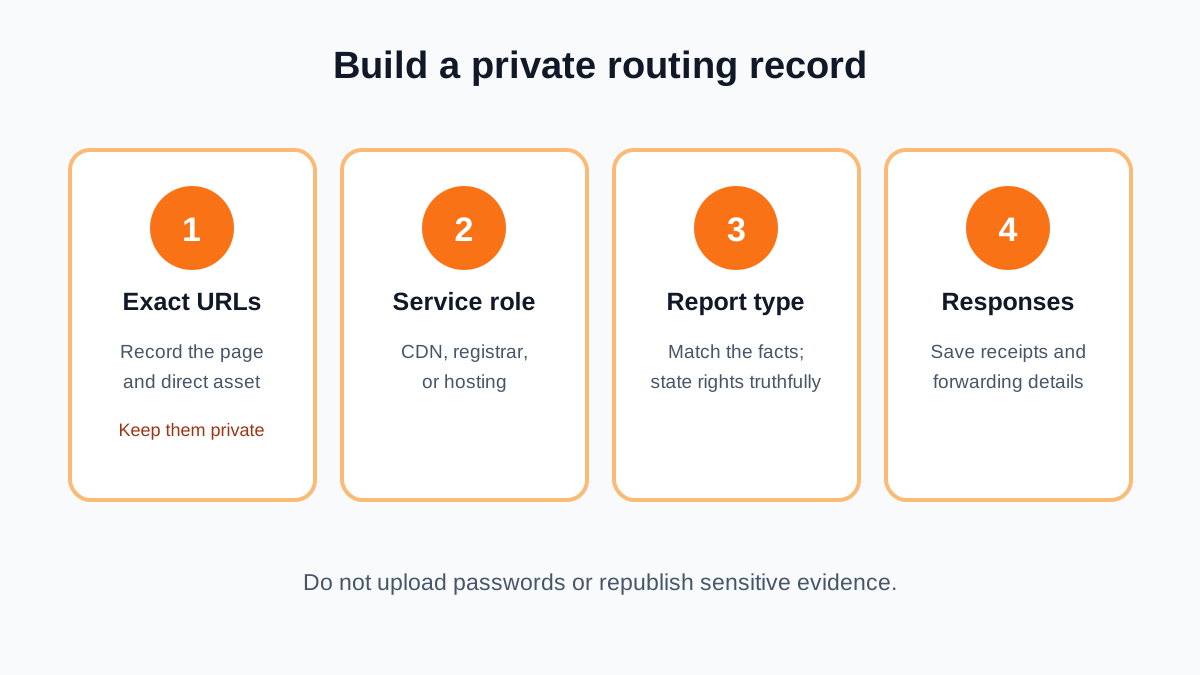
1. Record the exact content locations
Save the full page URL where the material appears and, only when safely available and required, the direct asset URL. Record the date checked and whether the page currently loads. Do not post the links in a public document, download extra copies, or send passwords.
- Page URL: gives reviewers the surrounding location.
- Direct asset URL: may identify the specific image or video file.
- Discovery date: anchors the status of a page that may change.
- Private case ID: connects receipts without exposing the subject publicly.
2. Separate Cloudflare’s possible roles
| Observed role | What it may mean | Likely parallel action |
|---|---|---|
| Pass-through CDN or security | Cloudflare sits between visitors and the origin | Identify and report to the origin host when appropriate |
| Domain registrar | Cloudflare manages registration, not necessarily the content server | Use the complaint path supported by the facts |
| Hosting at the edge | A Cloudflare service may host the reported content | Provide exact URLs for Cloudflare’s review |
A nameserver, response header, or Cloudflare-branded error page can show network involvement, but it does not by itself establish who controls the source files. Avoid claiming Cloudflare is the host unless the available evidence supports that conclusion.
3. Choose the complaint type truthfully
Cloudflare publishes complaint-specific requirements. A copyright notice is appropriate only for a copyright owner or authorized representative who can make the required statements truthfully. If the issue is non-consensual intimate material and ownership is uncertain, do not manufacture a copyright claim to fit a form.
4. Expect routing, not a guaranteed deletion
Cloudflare describes its abuse system as a way to present a grievance to the party positioned to address it. The available mitigation depends on the service at issue. A receipt may confirm intake or forwarding without proving that the source page has been removed.
5. Track every provider response separately
For each URL, record the Cloudflare receipt, any forwarding notice, the external host or site response, and the current page status. Recheck without repeatedly viewing or downloading sensitive material. Do not send duplicate reports unless an official instruction or response gives a reason to do so.
Current Cloudflare references
- Cloudflare’s abuse overview explains how its role varies across CDN, registrar, and hosting services.
- Cloudflare’s complaint types lists current requirements, including the details required for DMCA complaints.
- Cloudflare’s report-submission page lists its current reporting methods.
Need help routing a Cloudflare-related case?
Review the service scope, limitations, and private intake path before sharing any case details.
Review Cloudflare abuse report support →About the Author
Marcus covers the intersection of technology and privacy, with a focus on AI-generated content and emerging threats. He helps readers understand their options when facing online harassment.